English
 italiano


There are six primary types of sliding door handles: clamp-style, flush-mount, hook-style, internal-lock, standard pull, and long bar pull designs. For a framed aluminum patio door, a hook-style or internal-lock handle is the standard choice; for frameless glass doors, you need a clamp-style handle; and for pocket doors, a flush-mount pull is almost always the right answer. This guide compares all six types, explains the materials and finishes that matter, and gives you a practical checklist for choosing a replacement.
Sliding door handles do not operate a latch or retract a bolt the way lever handles on hinged doors do. They exist to give you a reliable grip on a door that moves along a track. That is why the mounting method, the door construction, and the locking option matter far more than the shape of the handle itself. Browse our sliding door handles collection to see common configurations, then read on for the details.
Content
The Six Main Types of Sliding Door Handles at a Glance
The six categories below cover essentially every sliding door handle you will find on residential and commercial doors. Use the table as a quick reference before reading the detailed explanations.
| Handle Type | Best For | How It Operates |
|---|---|---|
| Clamp-style | Frameless glass patio doors | Two plates clamp around the glass; no drilling required |
| Flush-mount | Pocket doors, minimalist interiors | Recessed pull sits flush with the door surface |
| Hook-style | Aluminum-framed sliding doors | Integrated hook grips the frame and acts as a pull |
| Internal-lock | Bedrooms, bathrooms, entry patio doors | Cylinder or thumb-turn lock built into the handle body |
| Standard pull | Heavy or wide sliding doors | Fixed metal grip mounted with screws; no latch |
| Long bar pull | Commercial spaces, ADA-compliant doors | Full-length bar mounted vertically or horizontally |
If you are replacing an existing handle, the current screw spacing will usually identify the style you need. A sliding door set mounted on a round or square rose follows a compact two-screw pattern, while a long bar pull uses three or more screws spaced far apart.
Sliding Door Handle Types Explained
Clamp-Style Handles for Frameless Glass Doors
Clamp-style handles are the only practical solution for frameless glass sliding doors, because they attach with compression plates instead of screws. Two metal plates sandwich the glass, typically 8 mm to 12 mm thick, and through-bolts pull them together. A rubber or nylon gasket sits between the metal and the glass so the panel is never stressed at one point. Tempered glass cannot be drilled without shattering, so clamping preserves the integrity of the panel. Clamp handles are widely used on shower doors, glass partitions, and frameless patio doors.
Flush-Mount Pull Handles for Pocket Doors
Flush-mount pulls are the best choice for pocket doors and any installation where a protruding handle would catch on clothing, block cabinetry, or prevent the door from sliding fully into a wall cavity. The pull is recessed into the door face, and finger clearance of 10 mm to 14 mm is enough for a comfortable grip. True flush pulls are routed into the door, while edge pulls mount on the door edge as a compact alternative. On retrofit projects, a rose-mounted flush-pull design delivers a similar low profile without cutting into the door.
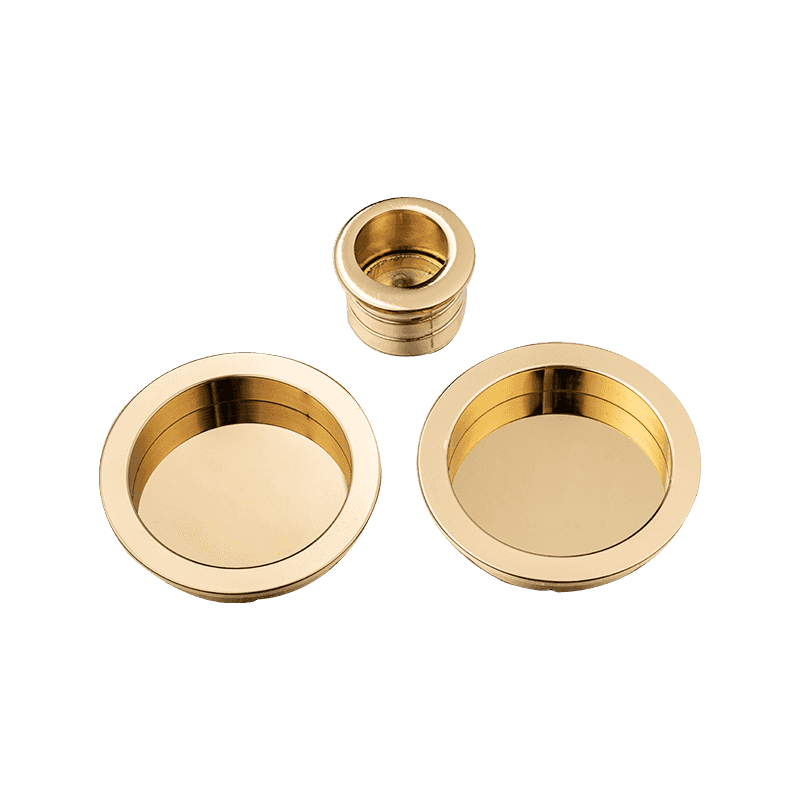 SD56 Sliding Door Rose with Flush Pull for Recessed GripThis rose-mounted flush pull offers a low-profile grip without routing into the door, ideal for retrofit projects. Its round finger pull fits the door edge and suits sliding doors.View Product →
Hook-Style Handles for Framed Sliding Doors
Hook-style handles are the standard on aluminum-framed patio doors because the integrated hook wraps around the door stile and gives you a secure edge grip. The hook catches the frame on the pull side, and the handle body is fixed to the interior face with two screws. This design is simple, durable, and inexpensive to replace, but it does not provide any locking function on its own. If security is required, pair a hook handle with a separate keyed sliding door lock.
Internal-Lock Handles for Privacy and Security
For bedrooms, bathrooms, and patio entry doors, an internal-lock sliding door handle with a built-in thumb-turn or keyed cylinder is the most secure and convenient option. The lock mechanism is integrated into the handle body, so you do not need a separate slide bolt or surface-mounted lock. Privacy versions use a thumb-turn and are common on bathroom and bedroom doors; passage versions have no lock and are intended for closet doors. Confirm the function, passage or privacy, before ordering.
 DPP02 Privacy Sliding Door Pull with Built-in Thumb TurnThis privacy pull integrates a thumb turn for locking from inside, making it suitable for bedrooms or bathrooms. It combines a pull and lock function in one compact handle assembly.View Product →
Standard Pull Handles and Long Bar Pulls
Standard pulls and long bar pulls are the most versatile category because they work on any sliding door with a flat surface that can accept screws. Standard pull handles include T-bars, curved grips, and block pulls, usually fixed with two or three screws on 32 mm, 38 mm, or 48 mm centers. Long bar pulls extend from 400 mm to 1200 mm and are frequently specified in commercial and ADA-compliant projects because a user can grab them at any height. For a simple bedroom or closet sliding door, a rose-mounted sliding door set offers an excellent balance of strength, compact aesthetics, and easy retrofit.
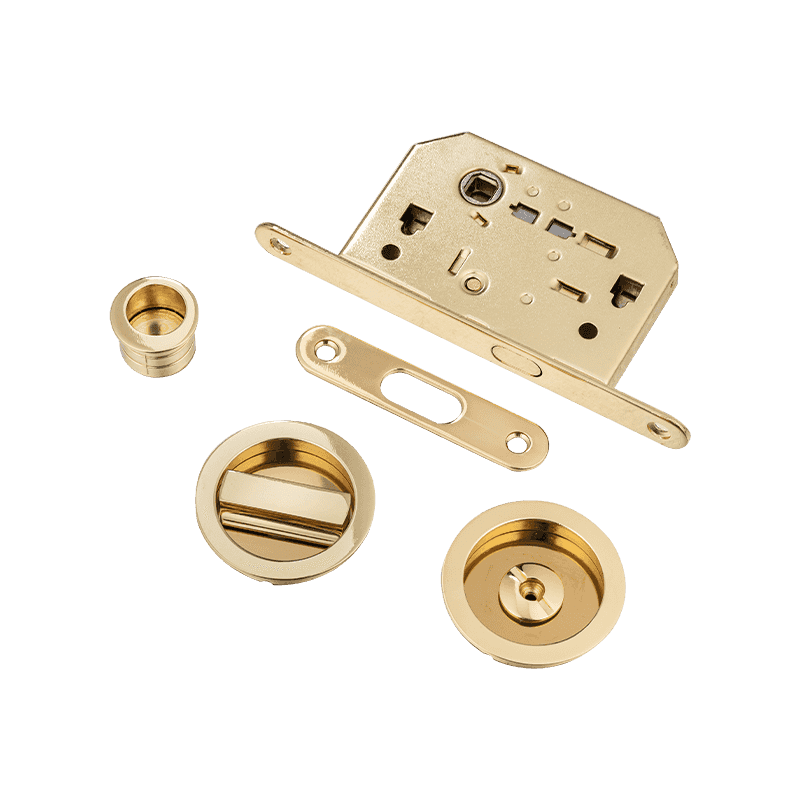 SD55 Sliding Door Set on Round Rose with Lock and PullsThis complete sliding door set includes a thumb turn, lock, and finger pull on round roses, offering privacy and easy operation for residential or commercial sliding doors.View Product →
Material and Finish Considerations
Zinc alloy, aluminum, and stainless steel account for nearly all sliding door handles on the market, and the best choice depends on the installation environment rather than the purchase price alone.
Zinc Alloy
Zinc alloy is the default for residential interior sliding door handles because it combines low cost, high casting detail, and good strength. It is easy to produce in complex shapes, which is why most lever-style and rose-mounted sliding sets use zinc alloy bodies. For dry interior conditions, a zinc alloy handle with a quality plated finish will last for decades without noticeable wear.
Aluminum
Aluminum is the material of choice for exterior and glass-door applications because it is lightweight and naturally corrosion-resistant. Anodized or powder-coated aluminum handles hold up well in rain, direct sunlight, and salt air. If your sliding door is in a coastal area, aluminum with a marine-grade coating is a solid middle ground between cost and longevity. Many clamp-style handles for glass doors use aluminum bodies for this reason.
Stainless Steel
Stainless steel is the right choice for coastal properties, pool enclosures, hospitals, and commercial kitchens where humidity, chemicals, and frequent cleaning are constant. Grade 304 stainless is the common specification for door hardware, and brushed or satin finishes hide fingerprints far better than mirror-polished surfaces. Stainless handles cost more, but they eliminate the rust and pitting problems that plated zinc and aluminum can develop in harsh environments.
Surface Finishes
Finish compatibility is what makes a sliding door handle look intentional rather than bolted on. The table below lists the most common finishes and where each one is best used.
| Finish | Appearance | Best Used In |
|---|---|---|
| Polished chrome | Bright, mirror-like | Contemporary bathrooms and high-gloss interiors |
| Satin chrome | Low-glare, soft sheen | Most residential interiors; easy to clean |
| Brushed nickel | Warm, subtle metallic | Traditional and transitional interiors |
| Matte black | Flat, modern, low reflection | Industrial, minimalist, and dark-accent rooms |
| Antique brass | Aged gold with patina over time | Classical and vintage-inspired spaces |
How to Choose the Right Sliding Door Handle
Choose a sliding door handle by evaluating four factors in order: door construction, security requirement, accessibility, and finish. Start by measuring the door thickness and identifying the existing mounting holes; this immediately rules out incompatible styles.
- Measure the door and glass thickness. Frameless glass doors take clamp-style handles only. Wood, aluminum, and composite frames take screw-mounted pulls, but the screw must bite into solid material. Hollow aluminum frames need a backing plate.
- Decide whether the door needs a lock. Bathroom and entry patio doors need a privacy or keyed internal-lock handle. Closet and hallway doors can use a plain pull or passage handle.
- Check the screw spacing. Common spacing on rose-mounted sliding sets is 38 mm or 43 mm. Long bar pulls use wider centers, so if you are replacing one, keep the existing holes or be prepared to fill and re-drill.
- Consider the reach and grip. For children, elderly users, or wheelchair access, a long bar pull or a vertical pull mounted at a comfortable height is far easier to use than a small flush pull.
- Match the finish to the rest of the room. Use the same finish as your door hinges, cabinet pulls, and lighting fixtures for a cohesive look.
When the door frame is old or non-standard, a surface-mounted sliding door set is usually the safer retrofit because the rose base covers the previous screw holes and provides a clean mounting surface. The square-rose design, in particular, offers a clear advantage in retrofit work: the larger plate hides a wider range of old hole patterns. You can read more about this in our guide to the advantages of the square-handle design of sliding door sets.
Installation Tips and Common Mistakes
Most sliding door handles install in under 30 minutes with a Phillips screwdriver and a hex key, provided you verify one thing first: the door frame must have enough material for the screws to bite into. Hollow aluminum frames strip easily when the screw only grips a thin wall.
- Use a backing plate. On hollow frames, install a steel backing plate or use self-tapping screws with a rubber gasket to distribute the load.
- Do not overtighten. Zinc and aluminum castings can crack if overtorqued. Tighten the screws until the handle is firm, then stop.
- Keep gaskets aligned. On clamp-style handles, a misaligned gasket lets moisture reach the glass edge, which can cause seal failure on insulated glass units.
- Check track clearance. A long bar pull may hit the door frame or wall when the door is fully open. Measure the available clearance before buying a full-length bar.
Frequently Asked Questions
Can I replace a hook-style handle with a flush pull?
Yes, if the door has a flat face and enough solid material to mount the flush pull. Most aluminum-frame doors need a backing plate, and you may need to fill the old hook slot. If the door is hollow, choose a surface-mounted pull on a rose instead.
What screw spacing is standard for sliding door handles?
Rose-mounted sliding door sets typically use 38 mm, 43 mm, or 48 mm centers. Long bar pulls use wider spacing, often 96 mm to 192 mm. Measure the distance between the centers of your existing screws before ordering a replacement.
Do sliding door handles come with locks?
Some do. Internal-lock sliding door handles integrate a privacy thumb-turn or a keyed cylinder directly into the handle body. Others, such as clamp-style or standard pull handles, do not. If your handle has no lock, you can add a separate keyed slide bolt or a surface-mounted lock near the top or bottom of the door.
Are long bar pulls required for ADA compliance?
ADA guidelines require operable hardware to be usable with one hand and without tight grasping, pinching, or twisting. A long bar pull satisfies this requirement because it can be operated with a closed fist. A small knob or flush pull may not comply unless it is designed for easy grip.
The six types of sliding door handles, clamp-style, flush-mount, hook-style, internal-lock, standard pull, and long bar pull, cover every common installation. Match the handle to the door construction first, then consider security, accessibility, and finish. A rose-mounted sliding door set is the most flexible retrofit option, with passage or privacy functions available at the same time. Use the tables and checklist in this guide to narrow the choice, and you will end up with a handle that operates smoothly and looks correct for years.