English
 italiano



A broken door handle is usually not a broken handle. In most cases the failure sits in one small, inexpensive part: the square spindle that carries the rotation, the spring cartridge that returns the lever to horizontal, the rose or backplate that clamps everything to the door, or the latch itself. Identify which of those has failed and you will know within five minutes whether you need a screwdriver, a spare part, or a complete new set.
Handles fail for predictable reasons. The return spring inside the rose is cycled every time someone walks through the door, the fixing screws work loose in a soft door core, and the spindle slowly wears rounded corners inside the latch follower. The visible lever often still looks perfect while the part doing the real work has already given up.
Do these three things before you buy anything:
- Remove the handle and photograph the mounting points, the spindle and the screw-hole spacing.
- Keep the old spindle. Its size, 7 mm or 8 mm square, decides whether a new handle will work at all.
- Check the other doors on the same run so the replacement still matches the finish and style.
Content
Diagnose the fault before you spend money
Every handle failure has a signature symptom, and each symptom points at a different component. Work down this table before ordering anything.
| Symptom | Most likely cause | Sensible action |
|---|---|---|
| Lever droops and will not spring back | Broken return spring or collapsed cartridge inside the rose | Replace the handle set; springs are matched to the casting and rarely sold separately |
| Lever turns freely but the latch does not move | Snapped spindle, or its corners rounded off | Replace the spindle first, then the latch if the follower is worn |
| Handle turns, latch moves, door still sticks | Latch and strike plate out of alignment | Adjust or file the strike plate, not the handle |
| Handle wobbles and screws will not tighten | Stripped screw holes in the door or in the rose | Fit threaded inserts or move to a backplate handle that spans the old holes |
| Handle comes away in your hand with the door shut | Failed fixing or snapped spindle on a through-bolt set | Free the latch with a thin tool, then replace the set |
| Key turns but the door will not unlock | Worn lock body or cylinder cam | Replace the lock body or the cylinder, not the lever |
The quickest test is to remove the handle and push a screwdriver into the square hole in the latch. If the latch throws and retracts smoothly, the door hardware is sound and only the handle assembly needs attention.
Make the door safe tonight
Security and safety come before appearance, because a door with a dead latch is a genuine risk rather than an inconvenience.
- Take the damaged handle off completely so it cannot jam the latch or fall on someone.
- Test the latch with a screwdriver. Smooth operation means the repair is limited to the handle and its fixings.
- Use the deadbolt or a secondary lock as the primary security until the replacement arrives.
- On an interior door, a wedge under the leaf stops it drifting open; on an exterior door, never rely on tape or a cable tie to hold a lever in place.
- If the latch itself is jammed while the door is shut, call a locksmith rather than forcing the lever, since a bent spindle can crack the lock case.
For a closer walkthrough of the temporary measures, including what to avoid on fire doors, our guide to temporary fixes and safety tips for a broken door knob covers the same ground in more detail.
Replace the handle or repair the door?
Replace the handle when the spring, cartridge or spindle has failed, and repair the door when the hardware is fine but the mounting has given way.
Replacing the set is the right call when:
- the lever no longer returns to horizontal, which means the spring cartridge is finished;
- the finish is worn through or pitted, so corrosion will keep working the mechanism loose;
- the model is more than a decade old and matching parts are no longer produced;
- the door is a commercial or rental entrance where a repeat failure costs far more than the part.
Repairing around the existing hardware makes sense when:
- only the spindle is bent or snapped, which is the cheapest and fastest fix;
- the screws have stripped in a soft door core and threaded inserts will hold;
- the latch and strike plate are misaligned, which is an adjustment rather than a replacement;
- the handle is part of a matched set on several doors and the casting is still sound.
Measure five things before you order
A replacement handle is only a drop-in fit when the spindle, screw centres and footprint all match; everything else is cosmetic.
| Measurement | What to record | Practical tolerance |
|---|---|---|
| Spindle | Square size (7 mm or 8 mm) and length | Size must match exactly; length within about 5 mm of the original |
| Door thickness | Leaf thickness at the handle position | 35–44 mm covers most interior doors |
| Fixing centres | Distance between the two screw holes | Match within 2 mm, or choose a plate and redrill |
| Rose or plate footprint | Diameter, or width × height | Equal to or larger than the old one to cover marks |
| Handing | Which side the lever sits on | Most sets are reversible; check before ordering handed pairs |
Two practical notes. If the old screw holes are enlarged, a backplate design is the cleaner solution because the plate spans the damage and spreads the load across fresh timber. And if the leaf is thicker than 44 mm, as fire doors and many external entrances are, check the through-bolt length instead of assuming a standard set will clamp.
Choose the replacement for the door it serves
Match the handle to the traffic the door actually sees rather than to the look of the room alone, because a light interior set on an entrance will fail again within a year.
Duty rating comes first
Residential interior doors tolerate a light spring and a hollow casting. Entrances, hotel corridors and office doors need a solid lever, a stronger spring and through-bolt fixings, because they cycle dozens of times a day. If the old handle failed at the spring rather than at the finish, that is usually a sign the set was under-specified for the traffic.
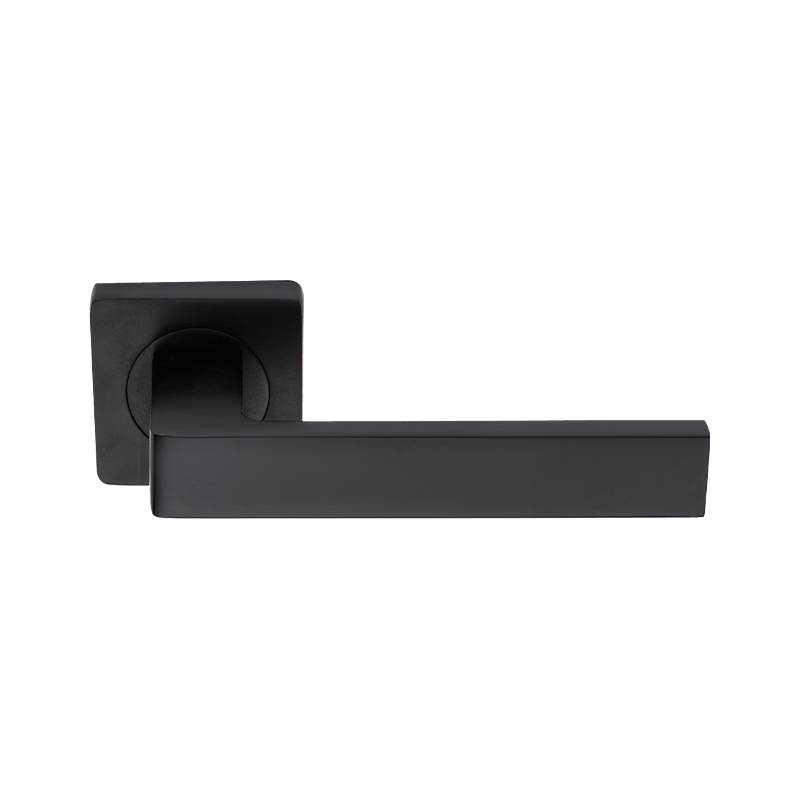
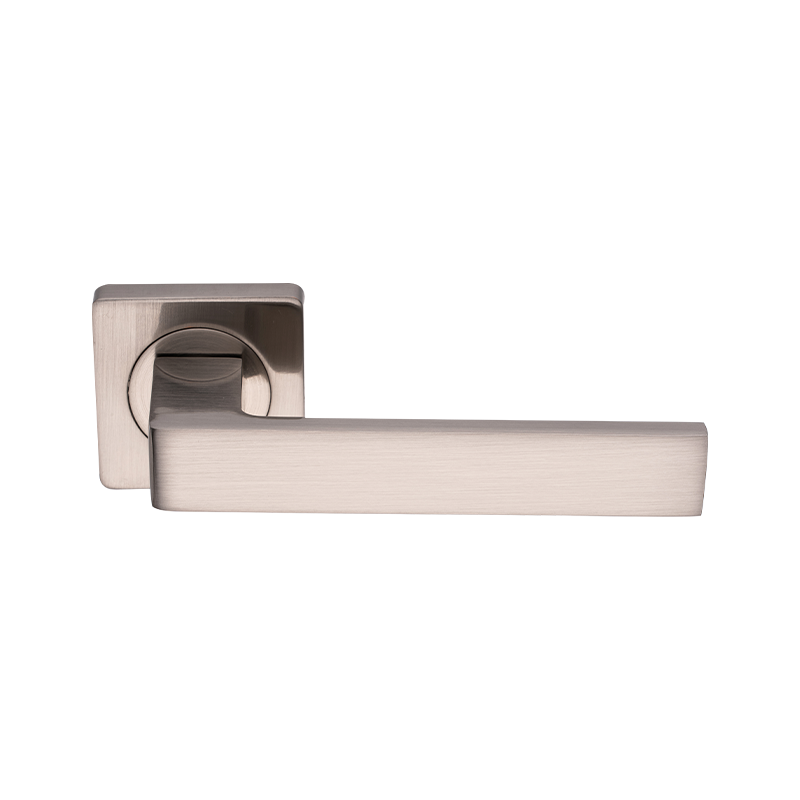 Heavy-Duty Passage Door Lever with Square RosetteA solid lever set for passage doors and high-traffic use, with a tiered angled lever, square rose and multiple finish options.View Product →
Material and finish
Zinc alloy offers the widest choice of shapes and holds a crisp finish. Aluminium is lighter and cheaper but dents more easily. Stainless steel is the sensible choice for coastal air, bathrooms and anywhere cleaning chemicals are used daily. Match the finish to the rest of the door furniture, and remember that polished surfaces show fingerprints while brushed and matte finishes hide them.
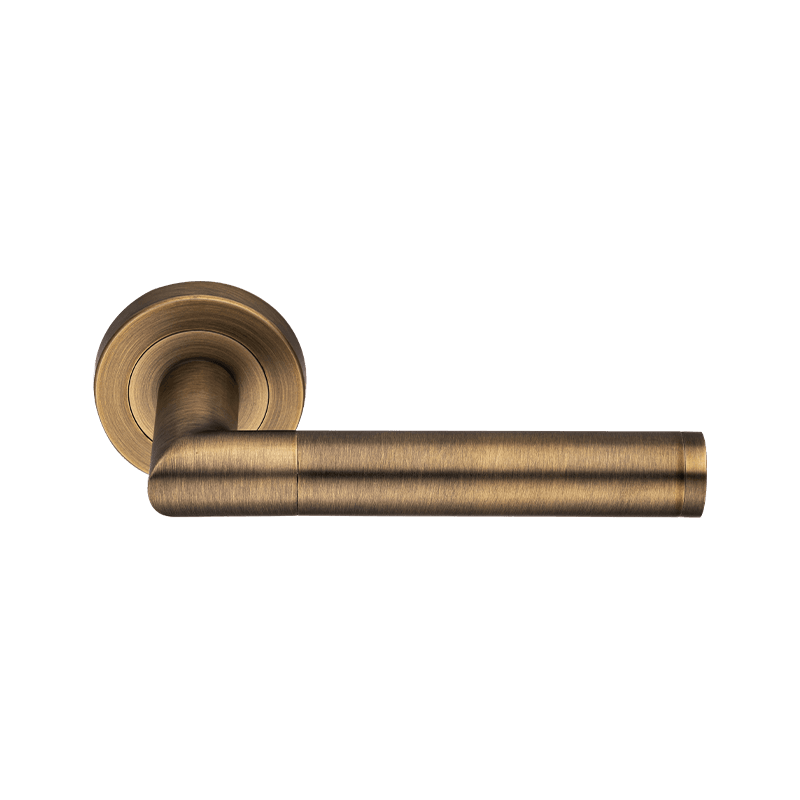
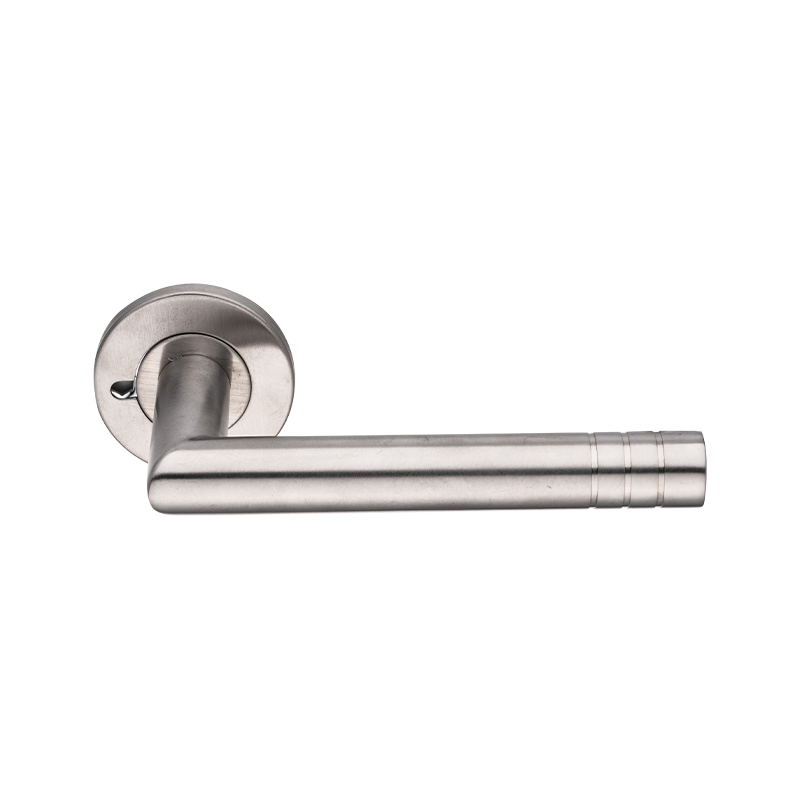 Brushed Stainless Steel Hollow Lever Handle on RoseA curved tubular stainless steel lever on rose for 35–44 mm doors, with a brushed finish and a modern profile for interior doors.View Product →
Fit, grip and clearance
Check that the lever clears the door frame and any cabinet beside it, and that the return feels comfortable for the people who use the door every day. A plate-mounted model is the safer choice when the original screw holes are tired, since the plate covers the old damage and gives the fixings fresh material to bite into.
 DH180B53 Integrated Flat Lever Door Handle On Plate Satin Chrome· The integrated flat handle matches with a 180mm wider backplate, suitable for domestic and commercial use.View Product →
If you are replacing for appearance rather than failure, browse the full lever door handles range and compare rose-mounted against plate-mounted designs before committing to a style across several doors.
When one handle fails, check the rest
In a building with repeated door types, a single broken handle is usually the first of a batch, because identical sets installed at the same time wear out within months of each other.
Walk the floor and test each lever for spring return and sideways wobble. Record the model, the spindle size and the finish, then keep two or three spare sets on site. A stocked spare converts a two-day security problem into a fifteen-minute swap, and it stops maintenance teams from fitting mismatched handles that later make an entire corridor look patched.
Frequently asked questions
Can a broken door handle be glued back together?
No. Adhesive will not carry the torque of a lever, and a glued joint fails without warning, often with the door shut. The correct fix is a new spindle, spring cartridge or complete set, depending on which part failed.
Why did the handle break in the first place?
Almost always through cycle wear, an under-specified duty rating, loose fixings that let the mechanism rock, or corrosion in a damp environment. Occasional excessive force, such as pulling a stuck door by the lever, accelerates all four.
Can I replace just the lever and keep the existing rose?
Sometimes, but only when the new lever comes from the same series as the old one, because the spindle bore, spring position and grub-screw location must align. On older or discontinued models it is faster and usually cheaper to replace the whole set.
How long should a door handle last?
It depends far more on cycles than on calendar years. A lightly used interior handle can stay smooth for a decade or more, while an entrance or corridor door may wear out its spring in two or three years. Judging by cycles explains why identical handles in the same building fail at very different times.
The lever snapped and the door is locked. What now?
Do not force the stub. Push a thin screwdriver or a stiff wire into the exposed follower to retract the latch, or use the second side if the set is still partly intact. Once the door is open, remove the handle and replace it rather than attempting a field repair.
A failed handle is a maintenance event, not a crisis. Strip it down, identify whether the spindle, spring, fixing or latch has failed, make the door secure with the deadbolt, and measure the spindle, screw centres, footprint and leaf thickness before you order. That sequence turns a broken door handle into a fifteen-minute repair, and it prevents the most common mistake of all: buying a good-looking handle that will not fit the door it was meant to save.